Read Zeolites and Metal-Organic Frameworks: From Lab to Industry - Vincent Blay | PDF
Related searches:
Zeolites and Metal-Organic Frameworks Amsterdam University Press
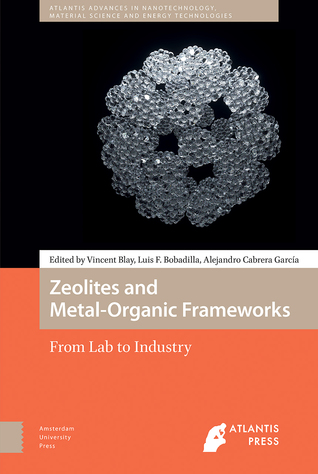
Zeolites and Metal-Organic Frameworks: From Lab to Industry
Zeolites and Metal-Organic Frameworks – From Lab to Industry De
Landscape of Research Areas for Zeolites and Metal-Organic
Development and Evaluation of Zeolites and Metal–Organic
Reverse selectivity of zeolites and metal-organic frameworks in the
The materials of the future, today. Zeolites and Metal-Organic
Zeolites and Metal-Organic Frameworks on JSTOR
Amazon.com: Zeolites and Metal-Organic Frameworks: From Lab
(PDF) Zeolites and Metal-Organic Frameworks From Lab to Industry
Industrial Outlook on Zeolites and Metal Organic Frameworks
Comparison of MIL-101(Cr) metal-organic framework and 13X
Iodine Capture in Silver-Loaded Zeolites and Metal Organic
Computational screening of porous metal-organic frameworks and
A comparison of the CO2 capture characteristics of zeolites and
The Secrets Such Structures May Hold: Zeolites and Metal
Preparation of Zeolite ZSM5 and Catalysis of Xylene Isomerization
Slurry Preparation of Zeolite and Metal-Organic Framework for
Zeolites and Metal-Organic Frameworks - OAPEN
Recent progress in the design and synthesis of zeolite-like
Adsorption‑based fluorocarbon separation in zeolites and
Heterogeneous catalysis in zeolites, mesoporous silica, and metal–organic frameworks. 2 word cloud based on the top 50 high-cited papers with “metal-organic frameworks or mofs” in titles from the database web of science core collection on january 2, 2020.
Metal-organic frameworks (mofs) are synthetic compounds with crystalline microporous structures, consisting of metal centres joined by organic linkers.
Zeolites are natural or synthetic materials with porous chemical structures that are valuable due to their absorptive and catalytic qualities.
This review highlights various design and synthesis approaches toward the construction of zmofs, which are metal–organic frameworks (mofs) with topologies.
Computational screening of porous metal-organic frameworks and zeolites for the removal of so2 and nox from flue gases.
Book description: zeolites are natural or synthetic materials with porous chemical structures that are valuable due to their absorptive and catalytic qualities. Metal-organic frameworks (mofs) are manmade organometallic polymers with similar porous structures.
Metal–organic frameworks have recently emerged as a new class of porous.
Prominent examples of ordered porous materials include zeolites, mesoporous silica and metal–organic frameworks (mofs), which have been extensively.
Ionothermal synthesis, the use of ionic liquids as both solvent and template (structure-directing agent), has been used to prepare zeolites and inorganic–organic hybrids such as metal–organic frameworks. The underlying properties of the ionothermal method are discussed, and it is compared with traditional hydrothermal preparative methods.
Metal–organic frameworks (mof) materials are promising materials for gas separation, but their application still faces various challenges. A strategy is now reported for introducing subunits of mofs into traditional zeolite frameworks to obtain applicable adsorbents with advantages of both zeolites and mofs.
Metal-organic frameworks (mofs) are crystalline materials consisting of metal ions, or ion clusters, and organic ligands.
Zeolite and mofs are mainly used for co2 adsorption in the form of pellets and beads due to their good adsorptive property.
Zeolites are natural or synthetic materials with porous chemical structures that are valuable due to their absorptive and catalytic qualities. Metal-organic frameworks (mofs) are manmade organometallic polymers with similar porous structures.
The subject invention pertains to metal organic frameworks (mof) having zeolite- net-like topology, their methods of use, and their modes of synthesis.
We are interested in novel materials such as metal-organic frameworks (mofs), as well as traditional materials like zeolites that are already widely used in industry. Porous materials with well-controlled structures at the nanoscale can be extremely useful because of their ability to recognize and discriminate between adsorbed molecules.
28 29 microporous materials zeolites metal organic frameworks mof mesoporous from ms 4650 at national university of singapore.
Apr 11, 2018 zeolites are natural or synthetic materials with porous chemical structures that are valuable due to their absorptive and catalytic qualities.
Dec 1, 2020 metal-organic framework and 13x zeolite monoliths for co2 capture deal of previous work on co2 adsorption onto zeolites and mofs,.
Atomically dispersed metals on well-defined supports including zeolites and metal–organic frameworks: structure, bonding, reactivity, and catalysis melike babucci department of chemical engineering, university of california, davis, california, 95616, united states.
Metal-organic frameworks (mofs) are manmade organometallic polymers with similar porous structures. This introductory book, with contributions from top-class researchers from all around the world, examines these materials and explains the different synthetic routes available to prepare zeolites and mofs.
Jan 7, 2018 chemical engineer, phd title: zeolites and metal-organic frameworks.
Aug 30, 2019 performance of metal-free adsorbents (carbon, zeolite and mofs) were introduced.
Zeolites and metal-organic frameworks (mofs) are two common nanoporous materials, with pores less than and larger than 1 nanometer, respectively. In these pores, molecules can move and reactions can take place. Zeolites can be catalysts, while mofs make ideal support structures for catalysis or catalysts themselves.
Ordered porous materials are a class of materials featuring a well-defined framework that forms nanometer-sized channels and cages. Prominent examples of ordered porous materials include zeolites, mesoporous silica and metal–organic frameworks (mofs), which have been extensively studied owing to their existi.
3 (2,3,6,7,10,11-hexaiminotriphenylene) 2 was shown to be a metal-organic graphene analogue that has a natural band gap, making it a semiconductor, and is able to self-assemble.
Metal–organic frame-works (mofs) and zeolites are the two of the most important porous materials being used in heterogeneous catalysis. Metal–organic frameworks are highly porous materials and have widely attracted the attention of mate-rial scientists due to their exciting properties and applica-tions.
In contrast with zeolites, mofs are constructed from bridging organic ligands that remain intact throughout the synthesis.
Characterization of adsorption enthalpy of novel water-stable zeolites and metal-organic frameworks.
Zeolites, (silico)aluminophosphates, other zeo-type metallosilicates, and metal-organic frameworks are made of three-dimensional crystalline networks that preferentially adsorb molecules and exclude larger ones.
Zeolites and metal-organic frameworks (mofs) (figure 1) are a well-established family of nanoporous materials which can be used in heterogeneous catalysis.
Zeolites are very interesting crystalline compounds that in some cases occur over different 130 framework arrangements of the tetrahedral groups are known.
5 zeolite possesses powerful it is important that the clinoptilolite raw source material is tested for heavy metal.
Post Your Comments: